Breathing In the Air on Magic Mountain: With Hannah Cohen

By: Josh Kitchen / December 18, 2025

Hannah Cohen is sitting in her Catskills mountain cabin, furnished with rustic stonework and warm wood ceilings. She’s in a cozy knit sweater, her pup Jan—short for Janis Joplin—snoozing just off to her left. Outside, the property is covered in a blanket of snow, pine and hemlock poking through a wintry dreamscape. The air is crisp and pure.
This is the world where Cohen wrote and recorded her first album in over five years, Earthstar Mountain. Named after one of the many types of mushrooms that dot the mountainous landscape—the Earthstar, which Cohen tells me the area’s original Native inhabitants once used for lung tinctures and respiratory care—the title feels deeply intentional. It makes sense when you consider the way you can breathe the icy air deep into your lungs here, a feeling of renewal and rebirth that comes with that first cold inhale.

That’s what Earthstar Mountain sounds like. It’s a record shaped by its surroundings—organic, fulfilling, and full of variation and texture that could only exist in a place like this. From the the kaleidoscopic and dreamy “Earthstar,” to the disco romp “Summer Sweat,” and the folky “Draggin’,” listeners have much to cling to on this record. Alongside her partner and collaborator Sam Evian, Cohen has built a life in the natural quiet of these mountains, neighbors and friends drifting in and out of daily life, a community grounded in nature and reset from years spent in the city.
So many classic albums are borne out of this transcendentalist-inspired way of living—The Band’s Music From Big Pink, Dylan’s John Wesley Harding, Springsteen’s Nebraska, to name a few. Earthstar Mountain belongs to that tradition, and listening to it, you can almost smell the frozen air. I spoke with Cohen about the magic of her mountain, how it found its way onto one of the best albums of the year, and how it inspired her to change her outlook on life and return to songwriting.
How’s the mountain today?
The mountain is wonderful. It’s very cold, in the teens, and there’s a blanket of snow over everything, which is really nice. Where we live, a lot of the stuff loses its leaves, which can be depressing. There are some pines and hemlocks, but when everything turns brown and wintry, it can feel that way. So there’s a nice, magical blanket of snow over everything, and it’s cozy.
I’m glad you used the word magical. When I listen to the record, I hear that. The songs sound natural and organic in a way that could only arise out of the surroundings you’ve chosen to live and record them in. This is also your first record in six years, so my question is—why release new music now?
I think it took me a while to collect the songs that I wanted to put out. I just kept writing and living life, and other projects came up—like starting this studio with my partner, Sam Evian, and doing renovations and getting the property in shape. Coming to this land, there was a lot to process and understand. I was in New York City for fifteen years, so I was acclimating to this new environment. There was a change in pace in what my life was and what it meant to me.
My songwriting has always been about love, relationships, and life, so moving up here really changed my perspective on what a life could be.
Some of my favorite records are ones that were made in a secluded, organic environment—like The Band’s Music From Big Pink or Springsteen’s Nebraska—so I hear Earthstar Mountain in that context. It’s not lost on me that you’re right down the road from Woodstock, so I’m also thinking of Dylan and Joni Mitchell. It feels like these songs could only be born out of that.
It’s nice to think of it that way. I think it’s definitely a product of the environment, and very much the product of something that Sam and I make together. I write the songs, but he’s the producer and sort of my translator. I like to think of us as weaving together this tapestry.

So much great music comes from collaboration, and you can really hear that on the record. There’s Sam, but also friends like Sufjan Stevens, who you’ve known for many years, and Clairo joining in here.
I felt so lucky to have all the collaborators on there, including Sean Mullins. He’s such an important piece of the record as well, and just so in tune musically—such a sensitive drummer. There are so many things that have to align: the players, the music, the production, the day, the time. With this record, it took me time to pull those elements together. I had so many other things going on that I could only piece the record together over time.
But I also really loved having that time to edit and marinate on the songs, like it was a puzzle. I’d take songs away and put them back. Then I ended up writing the song “Mountain” and recording our version of “Una Spiaggia.” They were the missing pieces that made the record make sense, because it is a very eclectic record. I want to continue that with my music. I like dancing along to so many genres. I aspire to be a genre shapeshifter because I have so many influences—I love disco, funk, soul, country, and pop.

You’ve been playing these songs on tour for close to a year now. How do they continue to grow and evolve live?
It’s funny—“Draggin’” is so potent now when we do it live. I have this new falsetto riff at the end where I just go for it, and it’s turned into something new. It’s the song we all look forward to playing. There’s this energy that comes with it. I want to do a live version of it—maybe this winter we’ll get the homies up and record it like that.
That’s a big part of making music up here and being with our friends. A lot of our friends live up here, but a lot of them are still in the city, and they’re collaborators that we send things to and record with. For the last six years or so, we’ve had our friends come up for New Year’s. There’s a big group of us, and we record and work on music—everybody’s music—for the week. But it’s all about the hang. It’s about making meals together and sharing this with our friends, because we feel so lucky that we get to live here. And, you know, being musicians and artists,
I’m kind of like, how am I allowed to live here like this?
You can hear that sense of the mountain and the community all over this record—so much so that you named the album after it. There are a lot of different mushrooms growing on the property, including the Earthstar. Are they edible?
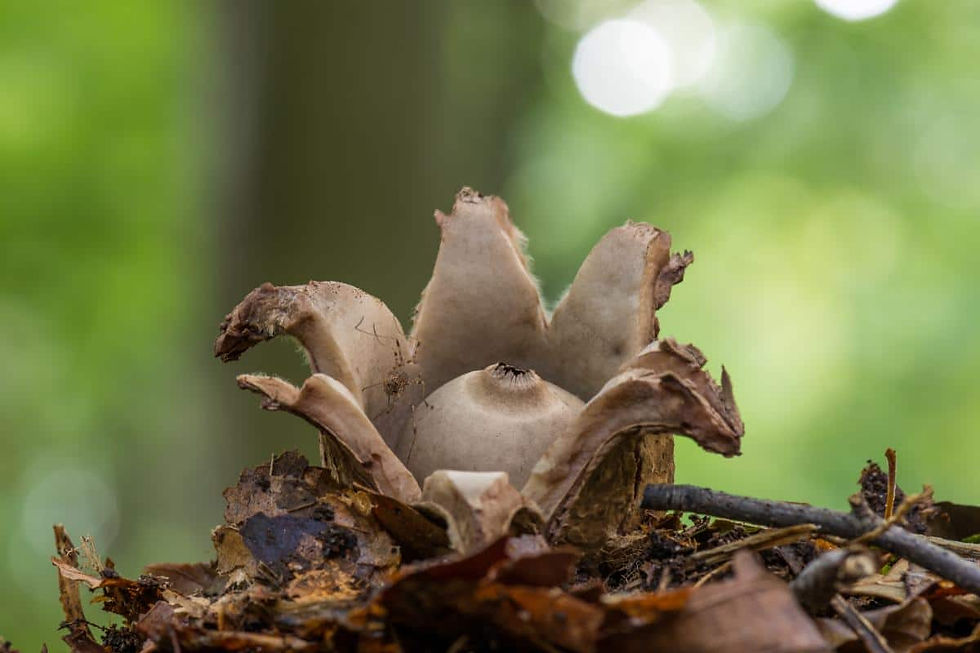
I think you can, but they wouldn’t taste good. I’m not going to advise eating them, but apparently the native people of the area would use them as lung tinctures and respiratory aids.
I would imagine breathing in the winter air there is pretty special.
It really is. We’re right next to the creek, and there’s always the sound of water when you go outside or crack a window open, which I just did. In Germany, it’s very popular to open all your windows and let fresh air in, even if it’s freezing outside. If there’s stagnant energy, that air will make you feel alive. I was just breathing in the fresh air.
What’s something you’ve learned about yourself this year, putting this new piece of yourself out into the world and touring it?
That I can do hard things. That I can put myself through the ringer and still be okay. I also learned that I need to keep something for myself. I’m a pretty open book—maybe to a fault. I’m not going to cover things up; I like to get it out. But I’ve learned that I need my quiet time too, and that I need to prioritize my peace.


Comments