Modern Woman Let You Into Their Dreamworld

By: Josh Kitchen / June 10, 2026
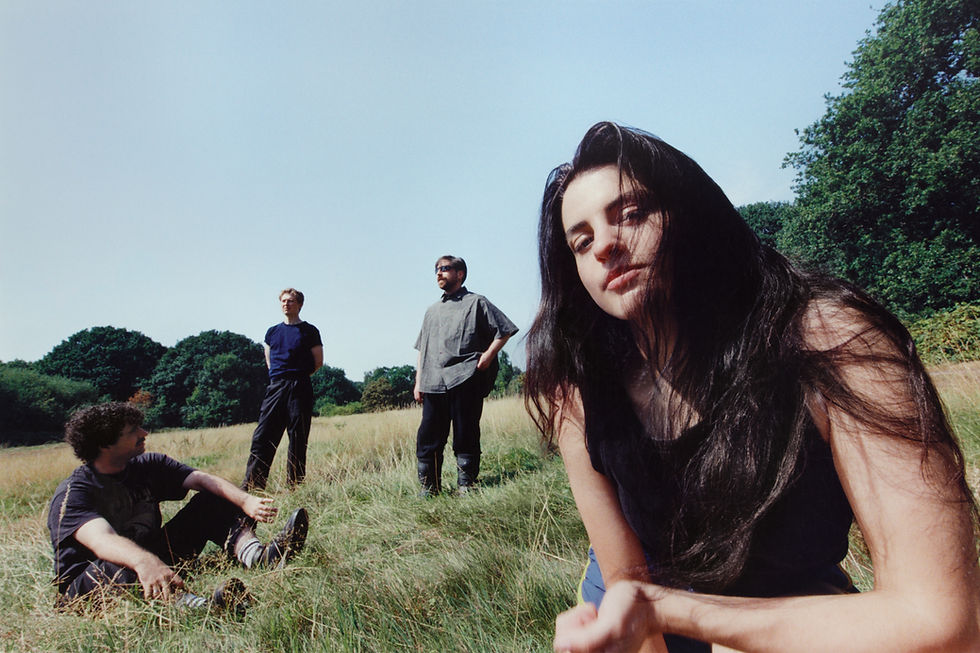
On the title track of their debut album, Johnny's Dreamworld, Sophie Harris—lead singer and songwriter of London four-piece Modern Woman—draws listeners into a world suspended between fantasy and reality. Slippery, tense, and propelled by a hypnotic groove, the song unfolds with a slow-motion swagger that's mysterious as it is unsettling.
Across the album's nine tracks and 33-minute runtime, frenetic guitar solos abound while Harris' voice shifts effortlessly between operatic wails, primal screams, and hushed whispers. At various moments, she recalls Kate Bush and PJ Harvey, while the band's jagged intensity evokes Fun House-era Stooges, Black Country, New Road, and the atmospheric grandeur of Nick Cave & The Bad Seeds' Warren Ellis years.
"I could oil your machine / You could be Harry Dean Stanton / I'll wear magenta on screen," Harris sings, her powerful voice drifting through the track like a half-remembered scene. The lyrics evoke a cinematic dreamscape, with the mention of Stanton conjuring the off-kilter worlds of David Lynch. Beneath it all, a pulsing rhythm anchors the song—the groove crafted by bassist Juan Brint-Guiterrez and drummer Adam Blackhurst, whose understated chemistry gives the track its magnetic pull.
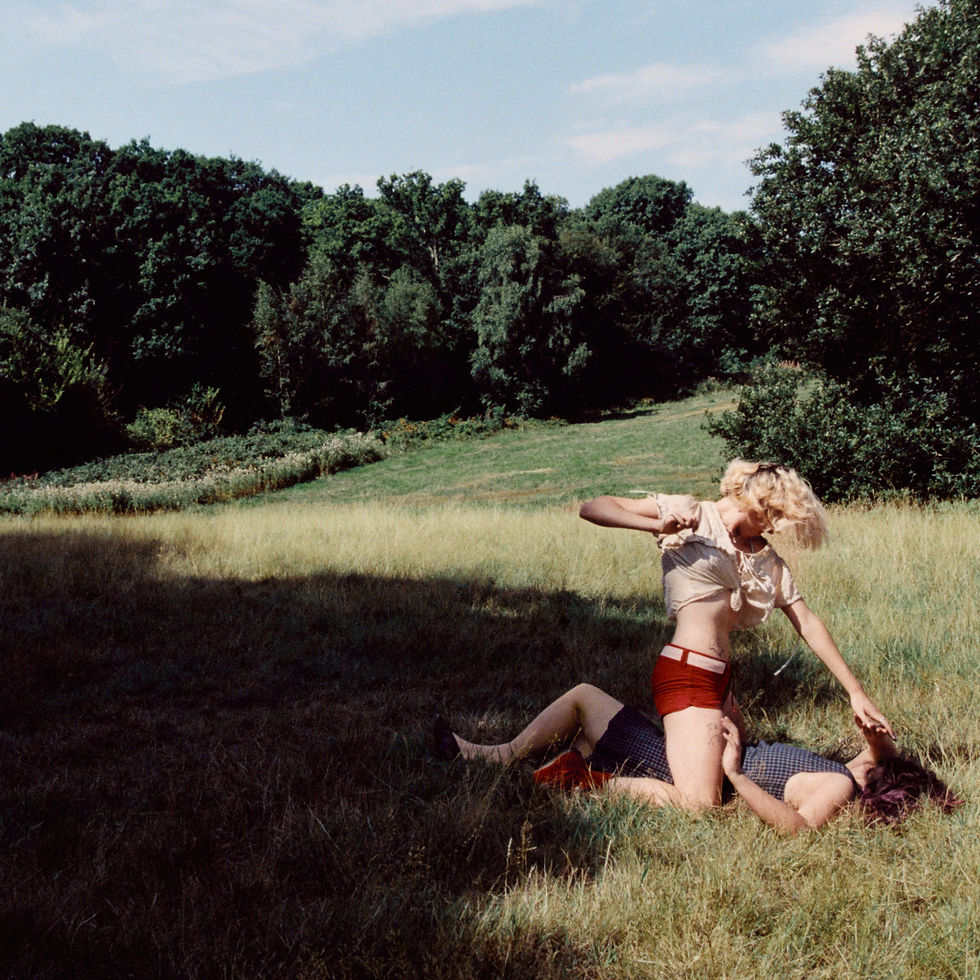
That sense of dream logic runs throughout the record. Drawing inspiration from poetry, literature, and medieval dream visions, Harris fills Johnny's Dreamworld with references that feel both timeless and also completely out of space and time - Harris and the band creating a world entirely their own. The album's closer, "The Garden," was inspired by a book she read about Joan of Arc, while elsewhere nods to Wordsworth emerge from the haze. "I did a module on medieval dream visions at university, and I could never get it out of my head—the landscapes and architecture within them," Harris tells me over email.
Suddenly, the album's strange internal logic begins to reveal itself. Johnny's Dreamworld doesn't unfold as a linear narrative so much as a series of emotional associations. Characters appear and disappear, symbols recur without explanation, and familiar places take on a neon glow. The result is a record that feels simultaneously archaic and modern, deeply personal and elusive—a romantic fever dream that seems to reveal everything while never fully giving itself away. I tried to make sense of it with Sophie Harris over email, where she talks about the way dreams influenced the record, seeing Nick Cave and Sinead O'Connor, and how Avril Lavigne had a chokehold over her pre-teen self.
A lot has been written about your singing and the art-pop, Kate Bush-adjacent qualities in your music, and I can hear that. But what many of these tracks actually remind me of are those orchestral, tension-filled moments in later-era Nick Cave and the Bad Seeds records — the way Nick Cave and Warren Ellis use violin, strings, negative space, and sudden bursts of noise so that quiet and chaos constantly feel like they’re pushing against each other. “Offerings” is a great example of this — how do you decide when to keep things restrained and intimate, and when to let them explode into those huge waves of sound?
That’s a very nice comparison, I’m a fan of all of pretty much all of Nick Cave and Warren Ellis’ work. We have always had a real interest in the use of shock in music, and big dynamic shifts, and I think we were particularly interested in doing that in this record. In many of the songs, it was important to me to try to foster a sense of tension and release, in a way that didn’t feel artificial. I think it just naturally happens in the room, I think we’re all on the same page with it. David composes for horror films, for example, so he really understands that tension and release in the way he creates an atmosphere for many of the songs, too.
And ironically, "Killing a Dog" which follows "Offerings," reminds me a lot of PJ Harvey's vocal style and delivery. There aren't many lyrics in this song, and yet you stretch them in a way that makes the song sound so much fuller, using the music to really expand on what you're saying. Do you often let the lyrics influence the music, or is it the other way around?
Thank you! I tend to let the music influence the lyrics, but I write some parts separately and then draw them together. A song usually has a certain feeling for me that I try to articulate in the words, sometimes they just form together, but often I use writing I have in different notebooks and notes apps, to help conceptualise those thoughts.
"Fork/Heart" opens so eerily, with that monotonous plucking. Something I love about the album is how so many of the songs create these little cinematic moments and scenes. Are you influenced by visual art? Films? I can see so many of these songs working in those mediums. (And I also think of the Harry Dean Stanton reference in the title track)

That was definitely what I wanted to do with the lyrics on this record, because I like the idea of each song being a contained snippet of thought or story in itself. That’s why I love songs, they’re often so short, but they can contain a lot. Reading was what I tended to lean towards more than film growing up, but in the last few years I’ve become more interested in film, and I think that came through in some of the more recent lyrics. I wanted the lyrics to be sort of colorful and vivid, so films felt helpful in that respect.
The title track has the sickest groove, drenched in strings and your insane singing - and the song is constantly tense and also flows at a brisk pace - these songs are so untraditional in their construction, but they just flatly work. It reminds me of so much great classical romantic composers. Is that world an influence on you and your writing?
That groove is the work of Juan Brint-Guiterrez, the bassist in Modern Woman and Adam Blackhurst, the drummer. They’re both incredible musicians, and I think unique in the way they think outside the box. Thank you so much. That’s interesting about romantic composers - I’ve never really thought about it that way, though there are many romantic composers I like and listen to.

You reference many different locations across the record: New England, New Jersey, Tokyo, Dovedale Street, Michigan. How important is it to you to tie ideas and lyrics to different places like this? Are they places you've visited, lived in, or are they fantasy versions?
It’s important because I think I do have locations in my mind a lot of the time when I write, because a lot of the lyrics are story-based in some respect and locations are important to those stories. Those are places I have lived in or visited, apart from Tokyo - I actually meant that to be half-hearted Lost in Translation reference, I think itself gets a little lost…
The garden as a theme also is important in the second half of the record. In "Folk/Heart," and then of course the closing track, "The Garden." Talk to me about the garden and what it means to you as a metaphor - the use of it in these songs couldn't be more different.
Yeah, being outside is really important to me, and always has been, so plants often work their way into a lot of things I write about by proxy. "The Garden," I wrote that when I was about 22, and it was after reading a book about Joan of Arc I found in a charity shop. It focused in a section on when a teenage Joan heard voices in her garden in France that ultimately led to her martyrdom. So I wrote a song about that moment because I thought it was interesting.
I think of the album title - Johnny's Dreamworld, and a dream world being really crucial to the entire record's themes, and the world you're creating here. I mentioned film, and Harry Dean Stanton, and it's hard to not think of David Lynch when I think about those two at once. Is Lynch an influence in that way? The record certainly makes me think of the worlds he creates, which are so intertwined with the music he uses and often creates himself for them - and the sounds here remind me of the sounds he would create - often quiet, tense, heavy, staticky, always working to evoke feeling and emotion from the audience.

I came to David Lynch quite late, I probably watched his films properly about 5 years ago, though I know David (in Modern Woman) has been a huge fan since he was young. Before that, I was interested in how dreams were presented in books, I did a module on medieval dream visions at university, and I could never get it out of my head the landscapes and architecture within them. And then I got heavily into Borges at one point. So I think I was just really was interested in dreams in writing. Then yeah, I do think when I watched David Lynch’s films, it felt like he articulated so well a lot of the things I was interested in, but modernized it. And I became really fixated on his work too. So I’m sure that comes out in the music in some way.
You've written poetry, and used to run poetry nights, I notice you even reference Wordsworth on the record. Are you into any modern poets?
I haven’t written poetry for a while actually. Maybe I will again. I’m into many modern poets, Alice Oswald, Warsan Shire and Sharon Olds particularly.
What's the last concert you saw? The best? The first?
The last concert I went to was a celebration of Marianne Faithful’s work and life, at the Barbican. Lots of artists covered her songs, from Anna Calvi to Rufus Wainwright to Jarvis Cocker. It was great. The best concert I have ever been to was a celebration of Shane MacGowan, for his 60th birthday at the National Concert Hall in Dublin. Artists like Sinead O’Connor, Lisa O’Neil and Nick Cave performed Pogues songs and MacGowan’s solo material. Watching Sinead O’Connor was a formative experience. The first concert was Avril Lavigne at what was then the MEN arena when I was about 7. As a pre-teen, she had a chokehold on me.
Finally, who's Johnny?
A character, a real person, just a name…who knows.


Comments