Pearl & The Oysters Calm Their Monkey Minds On New Album

By : Josh Kitchen / August 20, 2026

In Ram Dass’ seminal work on meditation, yoga, and spirituality, Be Here Now, he wrote, “The human mind is like that monkey, incessantly active by its own nature.” This idea, known as the “monkey mind,” in Buddhist terminology describes a restless, unfocused state of mind, where thoughts jump rapidly from branch to branch.
It’s within this framework that Pearl & The Oysters’ sixth album, appropriately titled Monkey Mind, takes shape. Led by Juliette Pearl Davis and Joachim Polack, the band’s own path has been nearly as eclectic as their music: the two met growing up in France, later moved to Gainesville, Florida, and eventually landed in Los Angeles, which they now call home. Along the way, Pearl & The Oysters have made a name for themselves as one of the finest indie synth-pop outfits working today, seamlessly blending retro sounds and futuristic atmospheres into catchy, jazzy, dance-floor-ready anthems that are as textured as they are immediate.
On Monkey Mind, the band took a different approach. Working with producer Jonathan Rado, Davis and Polack insisted on using only musicians who could be physically present in the studio, recording straight to tape with minimal overdubs. The result is perhaps Pearl & The Oysters’ finest record to date.
Written against the backdrop of the raging Los Angeles fires and the second Trump inauguration, which brought tremendous uncertainty and upheaval in early 2025, and with Davis dealing with ADHD, the concept of the “monkey mind” became a fitting framework for a record that demanded the band be organic and present—much in the same way they were trying to be themselves.
“I think a lot of us are dealing with looping, anxious minds, and I really found comfort in meditation and the Buddhist concept,” Davis told me. “It’s been helping me a lot to go through those phases.”
“I love the metaphor, the monkey jumping from branch to branch,” Polack said. “I feel like, because we're the internet-fed generation, that's how we also relate to musical styles and musical genres. This album was the official album where we're like, ‘We're done with trying to label this.’”
Monkey Mind ends up being just that—a record that jumps gleefully from branch to branch, completely uninterested in being defined by any one genre. After a decade of making music together, Pearl & The Oysters sound more like themselves than ever before.

Your new record, Monkey Mind, has been out for a little while now, and I love it. I was reading about how it was written at a time of great uncertainty. I live in L.A. too, so I felt a lot of what you guys were feeling during the fires and everything else going on. What I love about the record is that contrast: the music is so alive and fluid—you can really feel it and move to it—while it’s dealing with some very heavy things. Can you talk a little bit about that dynamic on Monkey Mind?
Joachim:
In a lot of ways, it's a heavy album. But yeah, I think one thing that comes to mind that I always seek out as a songwriter, and Juliette, I think, does too to an extent, is the tension between lyrics and music. There are definitely some genres of music, entire genres or styles, that are indexical of a certain emotion, and I think because of that, a lot of musicians are less likely to put them in conversation with lyrics that are a bit darker than what those could imply.
I think songs gain something, gain a third layer of meaning, when you superimpose a lyrical meaning that is kind of divorced from, I guess, musical indices or whatever. You know what I mean? I think of a lot of songwriters who have wielded that very well. Randy Newman is a big person that I will often cite when I talk about this album. But even to a lesser extent, and in a different, more world-building way, Donald Fagen. Or, as Juliette always likes to point out, the bossa nova lyricist Chico Buarque is amazing. When you don't understand Portuguese, you're like, "Oh, this song is about the flowers and the sun," and then it's like a political manifesto.
Not that we're Stereolab. I don't think that we want to be overtly about praxis and political action in the lyrics in a way that will alienate a lot of people who just want to listen to the music and feel good, because that's what we're about, and we've always been about trying to make music that uplifts. But also, as we grow older as songwriters and older as people, we're more concerned about the state of the world. Well, we've been for some time. The music and the lyrical approach have evolved a lot since the first few albums, and we tend to be a little bit darker.
Juliette:
One positive thing about it—it's not exactly positive, but there's a very luminous thing about writing this album. You were saying that you also dealt with heavy emotions around January 2025. We just crossed America this past month. There were fires everywhere. It's not only California, obviously.

Joachim:
Utah too.
Juliette:
And I think it was important for us to also make this album as a way to connect as humans with other people who are living similar anxieties or catastrophes, and trying to find a power in that connection through music and art. Just trying to transform those emotions and feel human with an album that's obviously 100% non-AI and also completely analog, recorded on tape very fast after we'd written the songs.
It was a very direct and human experience to do that, and we're so grateful that it seems like people are connecting with this. It's really just a wide-scale communication thing.
I love hearing you say that because, Joachim, you talked about bossa nova and how someone who doesn’t understand Portuguese might think a song is happy, but that’s just one language and one layer. Music itself is another form of communication: just because you can’t understand something doesn’t mean you can’t feel it. The lyrics can be saying one thing and the music another, and those layers make the experience so much richer.

That brings me to the title, Monkey Mind, which I know is a Buddhist term for a kind of restless, looping consciousness. I’m glad you brought up Newman—you could have called the album The Zen of Newman. Talk a little bit about the title and how that idea shaped the record.
Juliette:
I think a lot of us are dealing with looping, anxious minds, and I really found comfort in meditation and the Buddhist concept. It's been helping me a lot to go through those phases. We also thought there was a poetry in how the human mind works in general, going from thought to thought, and we thought it would be interesting to create a link between all of those drastically different thoughts that cross our minds, whether it's just plain thoughts or scrolling on our phones, and finding a unity in that through making a—I don't know if I would call it a concept album, but we did find a way to frame everything together by having this concept of a full day. It starts with waking up—
Joachim:
A day in the monkey mind.
Juliette:
A day in the monkey mind, yeah.
Joachim:
Also, the way the album weaves through different genres—or not necessarily genres, but the eclectic nature of the album—is also a product of a certain artistic monkey mind, in a way. I love the metaphor, the monkey jumping from branch to branch. I feel like, because we're the internet-fed generation, that's how we also relate to musical styles and musical genres. This album was the official album where we're like, "We're done with trying to label this."
Yeah. So much of what we listen to now is genre-less. It’s boring to say, “I’m a punk band, so I’m only going to make punk music.” The Clash are a punk band, but they don’t just make punk music.
Juliette:
It definitely doesn't work for us and how we grew.
Joachim:
It works for very few, to be honest. Very few artists find themselves really freed up by the idea of belonging to a school or a chapel. I find that it's just not how our generation has experienced music, post-high school at least. The reality is just that we listen to all kinds of stuff, and this album is a product of that. So Monkey Mind also makes sense in that regard.
It’s the same with who you are as artists. You met when you were young in France, then went to Gainesville, then L.A. There’s no other band that could sound like you because of those experiences. I mean, what’s your other favorite French-Floridian-L.A. band?
Joachim:
We're the sum of our experiences, for sure. It's true. We also have this very unique trajectory at this point, and I think that it made for unique music in a way. I'd like to think so.
You've been making music as Pearl & The Oysters for about a decade now, and it’s really rewarding to listen from the first record to now and hear that progression. Monkey Mind feels like a culmination of all of that while still doing new things—the analog approach, the loose concept, the semi-political nature of it. It feels both like the culmination of what you’ve done and another step forward.
Joachim:
That means a lot.
Juliette:
Thank you so much.

I’ve been sharing the record with people because I think it’s also a great introduction to you guys. You’ve been doing this for a decade, but someone could hear Monkey Mind and think, “Who is this great new band?” You’re perfect for Best New Artist—it’s always people—
Joachim:
That have been making music for 10 years.
Right!
Joachim:
Yeah, it's funny. I hope so. Frankly, since we signed to Stones Throw, I feel like every album has been a little bit more challenging musically, maybe as an aesthetic statement also. Not just in terms of the music itself, but also what narrative we're trying to convey with each album. Personally, I was so excited when we were writing it and making it, and I was really, really proud of it at every step of the way, and I am still. In a lot of ways, it's my favorite album we've made.

Juliette:
I feel it's really the album that's like, what happens if you put Pearl & The Oysters in a studio for 10 days with Jonathan Rado? We had to be very honest.
Joachim:
In that sense, I think you're right that it's a great intro because I think it's a very honest record. It really feels like a little Polaroid of a moment, emotionally and physically, and how we made it. You have to understand that the first few Pearl & The Oysters records were made across continents. People were sending us overdubs from Asia, and we loved that sort of global-village, internet collaboration—
Connectivity.
Joachim:
Yeah. It was great, and it was very of the time. Very Facebook. We had Facebook friends who were helping. I think that this is more like back to—
Analog.
Joachim: Right. Literally, this is a more IRL album.
Juliette:
Which was challenging sometimes. For example, my dad played vibraphone on most of our records, and it became a tradition at this point. But we made a rule: you had to be in the studio to appear on the album. You kind of had to be there.
On "Tracy Hills," we were thinking of asking our friend Clark Sound to sing for the duet, but then we're like, "Ah, he's in Georgia. He can't make it around the time of the recording." We didn't—
Joachim:
Want people to send us overdubs.
At least it's an equal-opportunity rule, so no one could get too offended.
Joachim:
That's true. We've made so many albums where we were literally trying to put all our friends on it. I feel like Canned Music, Flowerland—those are albums where it was really driven by this sense of trying to bring in as many people as we could, really build bridges through digital communication. Those were great to make in different ways, but I think they were less focused and less intentional and deliberate in the process of making them.
But I had a lot of fun making every single album. I do love to think that what you said is true and that it's a great introduction. One band that I love, for example, and that I'm always a little bit sad when I think about, is the High Llamas, because to me it's one of the greatest bands ever. I was listening to a Sean O'Hagan interview recently—maybe it was a podcast—and I think the interviewer was asking why they never became Stereolab. His answer was, "I think we were trying to be a little bit too clever," a little too niche, too esoteric, maybe.

I feel like Monkey Mind is more demanding in terms of the listener's prior knowledge of music and musical genres and repertoires than maybe an album like Coast 2 Coast, which is more immediate and funky. It goes for the sensory, like, headbang. Not all of the album, but the singles. I think we're really after hooks. We love hooks. We love a catchy chorus. At the end of the day, we want something that draws people in.
We write music that is very informed by that desire to connect, but we're also nerds. I think there's a tension there too. Sometimes I'm like, I wonder if the people who got on the train for Coast 2 Coast are still on it for Monkey Mind. I hope they are.
You mentioned some of the aesthetics and the visuals, which makes me think of our good friend Ambar [Navarro] and Max [Flick], who are incredible. I love what they did with you guys for "Lights Out" and "Mandarin Moon." Talk to me a little bit about that experience working on these videos.
Juliette:
This is a part of releasing an album that's been really fun throughout the years, and we were lucky to find incredible collaborators along the way that we've made multiple videos with. Just how the mind works—it's so interesting and incredible to witness the creativity that's in Ambar's mind. We sent the songs to her, and she immediately came up with ideas that were absolutely spot-on.
We didn't really know how to navigate the "Mandarin Moon" music video because the subject was so heavy. We didn't want to have flames. We didn't want to have something too on-the-nose with the fire, and we didn't want it to be completely off-topic either. Without even formulating that to her, she got this perfect idea.
It's so restrained.
Juliette:
And Max is just so talented.

Joachim:
Both of them are. It's one of the great joys of this band adventure for us, that we've gotten to collaborate with visual artists who are just phenomenal. I'm a fan of all of them.
Juliette:
We worked with Nikki Milan Houston, too, on a bunch of videos, and it's always so fun to find people who understand us but have ideas that we would never think of.
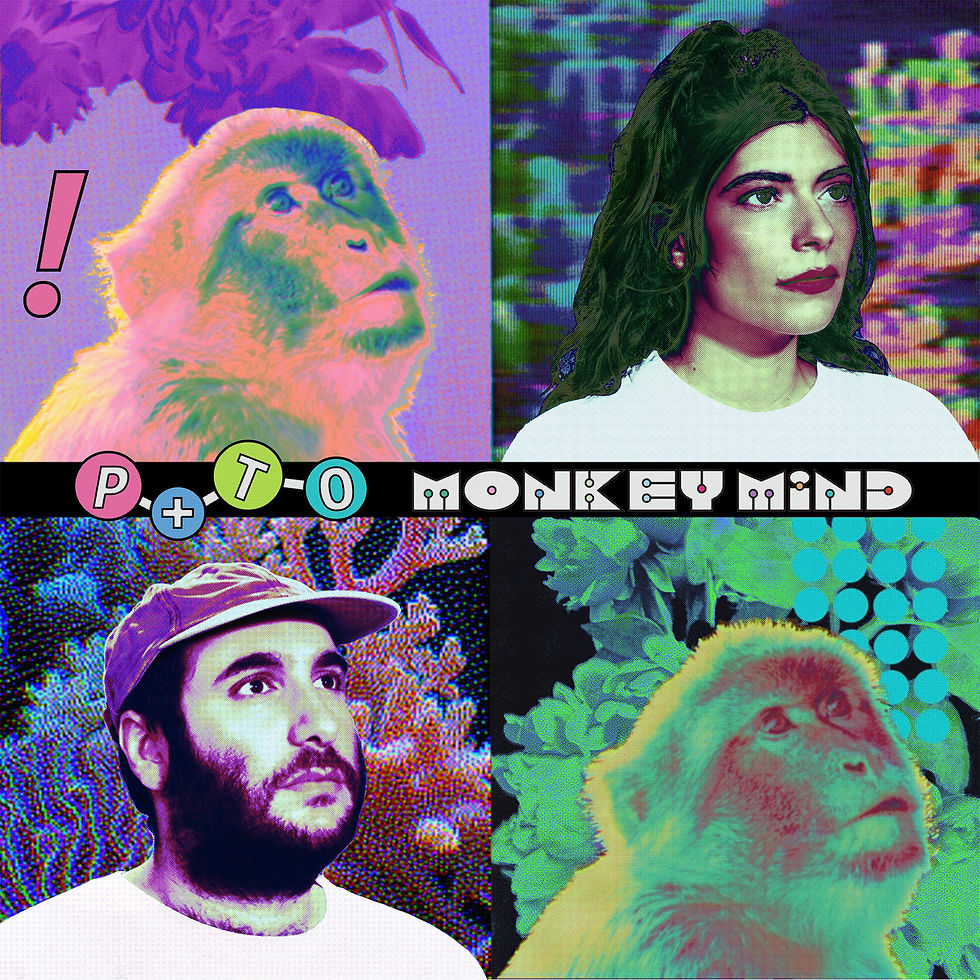
Then there’s the Monkey Mind album cover and those amazing, visceral colors. I love how the “Lights Out” video incorporates that same intense, washed-out feeling. From the cover alone, you’re creating this really visual experience that sets the tone for the record.
Juliette:
That was the first album cover for me, and I was really nervous. But my ideas were so clear in my mind. We were trying to make lists of artists we wanted to collaborate with, and then I was sketching out the idea for the album cover. It was so precise, and I was like, "What if I just did it?"
Joachim:
And it was really funny.
Juliette:
We asked Max to take the pictures of us, and we knew he would be perfect for it.
You got a monkey from SAG to come in.
Juliette:
The monkey preferred to stay anonymous, but yes.
I understand.
Juliette:
He was a great collaborator.
Who would play Pearl & The Oysters in a movie, and who is it directed by?
Juliette:
Oh, I love that question.
Joachim:
Who's playing us? That's tough. I don't know. Oh, I mean, I know, because I have a doppelgänger who's a French actor. Every time I go back to Paris and I enter a bar, people think I'm him. His name is Vincent Macaigne. For once, I'm not the one who's him.
I think he stole your look, honestly.
Joachim:
Yeah, he stole my exact thinning hair, the beard.
How about you, Juliette? Are we sticking with a French actress?
Juliette:
I used to be compared to Audrey Tautou a lot when I was younger. But I don't know. I don't look like her. I don't have her energy at all. But, wish list? I would love Kristen Stewart. She's incredible. I don't know why. She's a chameleon.
Joachim:
She can do anything.
Joachim:
She did Joan Jett!
Princess Di!
Juliette:
Director-wise -

Joachim:
Obayashi, the House director. Because it's very maximalist and full of effects, and I feel that it's kind of the visual or video equivalent, in terms of video effects, to what we try to make with bleeps and stuff.
Juliette:
And maybe Gregg Araki, for his colors.
Joachim:
I think Gregg Araki is so obsessed with aliens, especially alien reptiles. So yeah.
Juliette:
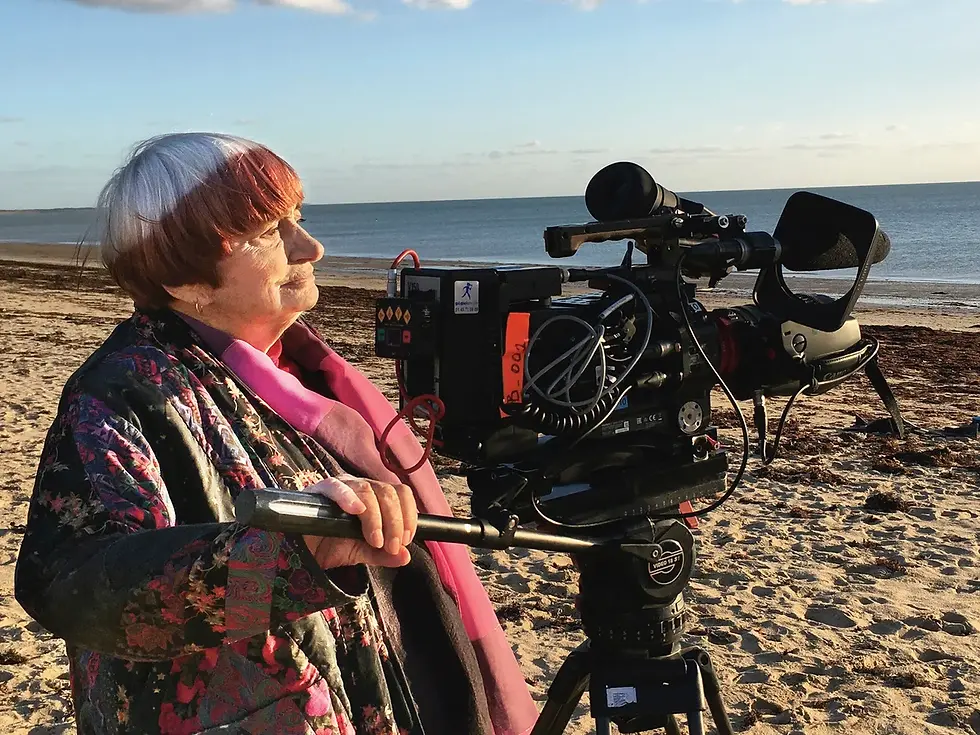
Agnès Varda!
Joachim:
Agnès Varda, but it would be more serious.
Juliette:
No, no, she's got a lot of humor!
And that movie is just called 'Pearl.'
Joachim:
She would come up with a pun.


Comments