A Twister To Blow Everything Down: Bella Litsa On Her Epic Debut Album - Drasticism

By: Josh Kitchen / February 24, 2026

“I’m drastic / I’m magic / You know this / You see it / I move you,” Bella Litsa sings on “My Blue Eyes,” a centerpiece off her aptly titled debut album Drasticism. The track builds slowly, Litsa pondering the mysteries of love, her voice rich and cloaked in a masterful Auto-Tune glow reminiscent of Caroline Polachek. At the midpoint, the song transforms into something else entirely, abruptly erupting into a fuzzy electric surge that whips up everything in its path before suddenly losing its ferocity to end Litsa’s meditation on love. It’s a track indicative of her style, where she allows the extreme feelings of life to collide into one beautiful cyclone of power — like a tornado born from the many sides of herself.

Litsa was born in Massachusetts, where she began learning piano at six, influenced greatly by the late Romantic-era composer Sergei Rachmaninoff and his penchant for emotional intensity and sweeping grandeur. Growing up, she'd often travel to Cyprus, where her father is from, and there she fell in love with the island — a place that inspired a deep sense of peace and tranquility within her. In 2020, Litsa moved to New York, where she fell in love with a city filled with intensity and often an abrasive cold, which she loves as well. Add in Lana Del Rey and her ability to turn a quiet, yearning feeling into an epic soundscape, Litsa’s musical oeuvre began to take shape — romantic, grandiose, with an ability to hold extreme opposites in her hands. It’s in this feeling that Drasticism was born.
It’s an album filled with the kind of ferocious intensity that can be born and die in an instant — music that is fleeting and infinite. On Drasticism, Litsa has dropped a stunning debut, these rich tapestries of feeling bursting out of each and every song. I caught up with Litsa to discuss the idea of these extremes, her upbringing in Cyprus and the East Coast of the United States, and how she finds beauty in the chaos.
Your debut album, Drasticism came out on Friday. I've been sitting with it for a while, and something that I love about it is how it comes from your classically trained background - I know you love Rachmaninoff. I think it's so evident on the record where there's quiet moments, and then BOOM, it kind of goes into these epic, orchestral sweeping moments. Can you talk a little about that?

I grew up listening to classical music, and I really connected to it. Especially Rachmaninoff. I think he has such an emotional tone. His music feels very sacred. He's writing music in a language I think I really understand, and when I write songs, I never even try to make these epic things, but I think it just kind of happens because of how much classical music has influenced me and hearing all these pieces with different movements, key changes, meter changes.
And he's so great at that. I love his Prelude in G minor, Prelude in B minor. That one's very underrated, I think. I actually took the melody from the B section of the Prelude in G minor, and that's the melody that I'm singing on "Never Ending Movie." You could hear it in his right hand. He's playing it through, and it's slowed down a lot, you know. But I wanted to try to really honor him in a song because of how massively influential he was. His melodies are just gorgeous. I just really understood it in this way that I think comes out now without me thinking about it all the time.
What's interesting about this connection also is that after Rachmaninoff debuted his Symphony No. 1, and it was received disastrously, he started hypnoanalysis. I know that you take part in psychoanalysis, and I think there's something very interesting in both of you as artists who are examining your inner psyches—not in exactly the same way—but still a way for someone in his time, which was very not the norm, to kind of go deep inside.
I love that story. It's so beautiful to me because he was doing it, I think, for four years. And then after that, the first piece he wrote was Concerto No. 2, the second concerto, which is his most beloved piece. And I just think that's so beautiful. He really took a step back, and I think in doing that, the music was able to really just kind of flow through him.
I think that idea comes through in Drasticism as well. When I hear this record, I feel like I understand you a little bit, I feel like I kind of understand how your mind works.

I think that's a huge reason why I love writing music so much because I think probably a lot of songwriters carry this—so much is left unsaid inside, and I can't figure out how to express it, or I'm too scared to express things to a person's face. So it turns into music, and then I get to say those things, and people hear it, and people witness you—the emotions of it and the words. To be witnessed, I think, is really powerful and important for certain people—I mean, for everyone. But I think maybe songwriters all share that in common—they need that witness.
And then you talk about this idea of extremes, which I think is really interesting—you have this epic push and pull of humanity and life's ideas on some of these songs, and then you get a kind of burst, like on “My Blue Eyes” or “Inside a Seashell.” It's a very fascinating idea to me.

Yeah - the extremity. I think a lot of these songs I just wrote when I was kind of crazy and just having these really intense experiences. Some of it was great, and then some of it's not great, and that's life. I feel a little bit more settled, now. But in those explosive moments, I think it's just another way of asking to be listened to. It's like, okay, I can be really peaceful and relaxing, but I think a lot of my music, really—it's kind of overwhelming—it's not background music. It's a little bit hard to ignore sometimes. And even I just feel that way when I listen to it. It's just very intense. And I know I'm asking for a lot with some of the songs, but it's just kind of what happened.
It's kind of hard to put this album on shuffle. I want to sit and listen to the whole thing because it's an experience where, like you say you're demanding to be heard, I think that is evident in this music. I wrote the word “crashing” down—like a massive crash of sound and emotion—especially on “Inside a Seashell.” It is loud, it is extreme, and sometimes it might not be the most peaceful feeling, but I think the way you've constructed this music, it weaves itself into a real peaceful noise, even though it's technically loud.
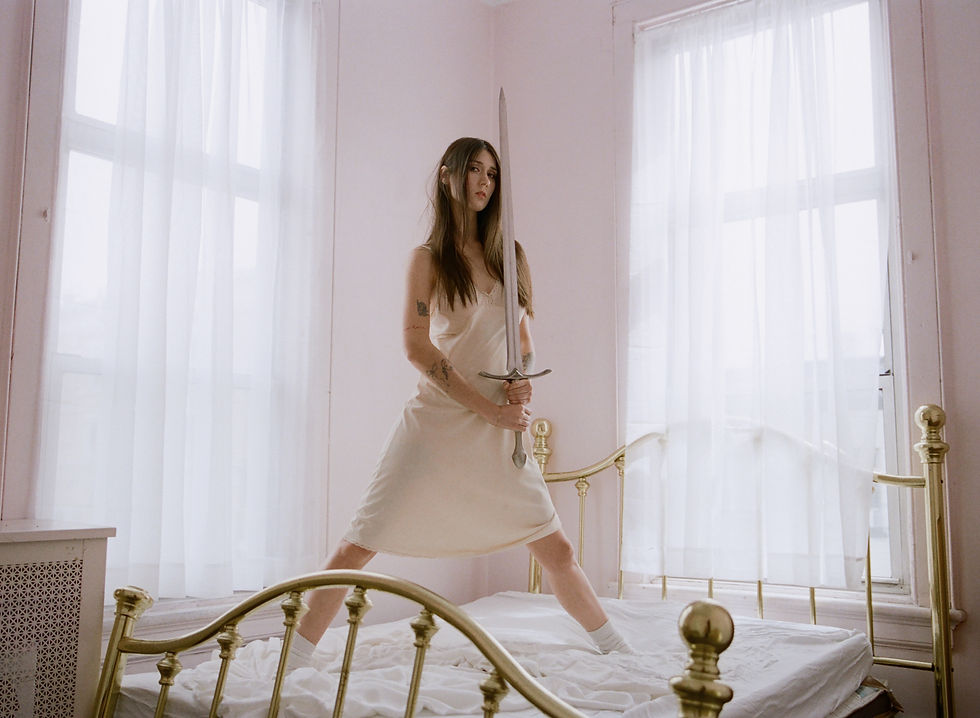
I like that word crashing because I feel like, yeah, I crash. I definitely personally feel like I can crash into people, can crash into things. And I was saying this the other day, which is a super intense thing, but I was talking about this with a friend, just remembering someone had once called me a tornado. And it was a person who knew me really well—like really, really well. And at first I was really offended by that. And then, you do analysis, and all of a sudden you're looking into the shadow, and I'm like, yeah, I totally can just become a tornado.
I think there can be beauty in that.
Right, because it's nothing to hide from. I think if you don't shy away from it and you just figure out how to make it work and figure out how to hone in on that—it can be controlled chaos. What's really interesting about tornadoes is they're made by different extreme polarity, which is also kind of what we were talking about with extremes and extreme opposites. I've had so many dreams about tornadoes, and I've never seen one in real life, but I dream about them.
Tornadoes and that kind of extreme weather are things that are sort of ingrained in our culture and collective consciousness. I think of The Wizard of Oz where it's a central theme. As a metaphor they're so interesting—they're devastating, but they can bring a kind of clarity.
And in The Wizard of Oz, you know, it's the tornado that takes her to this color filled transformation.
Tell me about how your artistry was shaped by growing up between Cyprus and New York—these two different backgrounds and worlds.
I grew up going to Cyprus, and it was just this really beautiful haven for me. And it still is. It is the most peaceful I ever feel, being there. I grew up mostly in Massachusetts, but going to Cyprus—it's so hard for me to leave. I just felt very connected to it. A lot of my firsts all happened there. I felt connected to the ocean, to the smell, to my family there, and just the soul of the island. So when I'm there, I just feel very peaceful and tranquil—the sound of the ocean, the heat. I love it.
And New York, I mean, the East Coast is very different. It's kind of abrasive and cold, which I also really like—extreme cold. But I wish I could have both at the same time, or both all the time, you know? Like, I wish I could have New York and Cyprus, but then Cyprus wouldn't be Cyprus, and New York wouldn't be New York. And I do love New York because I feel like most of the time I'm very driven, and I need to do a lot, and I love working and I love doing things as much as I love doing nothing. So I try to find the balance of doing both within a year.

Your longing for the feelings you get in Cyprus and the East Coast at the same time, it makes me think of the tornado metaphor again. When these two extremes come together, extreme hot and cold, it creates this monster of nature. You wish you could be in both places at the same time. I think on a record like Drasticism, you can hear those ideas. How did the album title come about?
I had this idea—I wanted to make an album. I'd wanted to make an album for a really long time, but I don't write songs super frequently—very sporadically. And I don't force myself into writing. I just kind of feel it and I do it, and I'm like, cool, another one. And there was this period of a couple months where I was all of a sudden writing a ton of songs that would eventually be on the album. And I started to feel like, oh, I think I have enough now. I think I have enough—I can make an album.
I was sending the early demos to my friend Dan English, who's also an amazing musician. I don't know if you've heard his album—it's called Sky Record. It's gorgeous—beautiful. And I was sending him the early demos, and he was really receptive to them and really liked them. It was nice to have that feedback. And he was asking me, you know, how the heck are you writing these things? Because of all the harmony changes. And I was like, you know, Dan, I live my life very drastically, honestly. I make all these crazy decisions, and then I have things to write about. And he's like, you should teach a class in that. I said I'd call it Drasticism 101 or something. And as soon as I wrote it down, I was like, oh my God, that's the name of the album. That's it. That's the name.
What’s a song you're excited for people to hear that they haven't yet?
"Saint Mishima," the album opener. I'm really happy with how it turned out. I think it's surprisingly more pop, or it has a sound that I don't think I'd really accessed before, which I was really happy about. And also, it's a song that has all these movements to it and I was just really happy with how it was able to come together. I think that a lot of the album is very sad and a bit slow, and that one is not that sad or not that slow.
It’s got to feel crazy for it to Finally come out.
It is so exciting. I mean, it means so much to me to have people support it. It's kind of so mind-blowing. It's very shocking when people tell you that they really liked it, because when I made it, I wasn't making it with that in mind at all. I was just kind of having the best time ever, being almost very hedonistic with it, just indulging what I wanted to do. And it's so cool. It's so cool. I mean, it means so much to me that people are receiving it. It's really sweet, and I feel like it makes me feel really connected to the world in this way that I don't always feel.
And the release show—it's the first time I've been playing shows like this. I played a ton of shows in 2025, but they were all very stripped down. I was just playing piano, and I had a flutist and guitar. And for this show, it's the first time the band is back together—everyone who recorded the album with me. We're playing together since recording it. So it's so fun to revisit the songs and see what feels different—what we didn't capture on the recording that we can capture now live, and how the voice feels on them. I feel a lot.
And I love singing. I just love singing.


Comments