Meeting Tyler Ballgame For The First Time, Again

By: Josh Kitchen / February 19, 2026

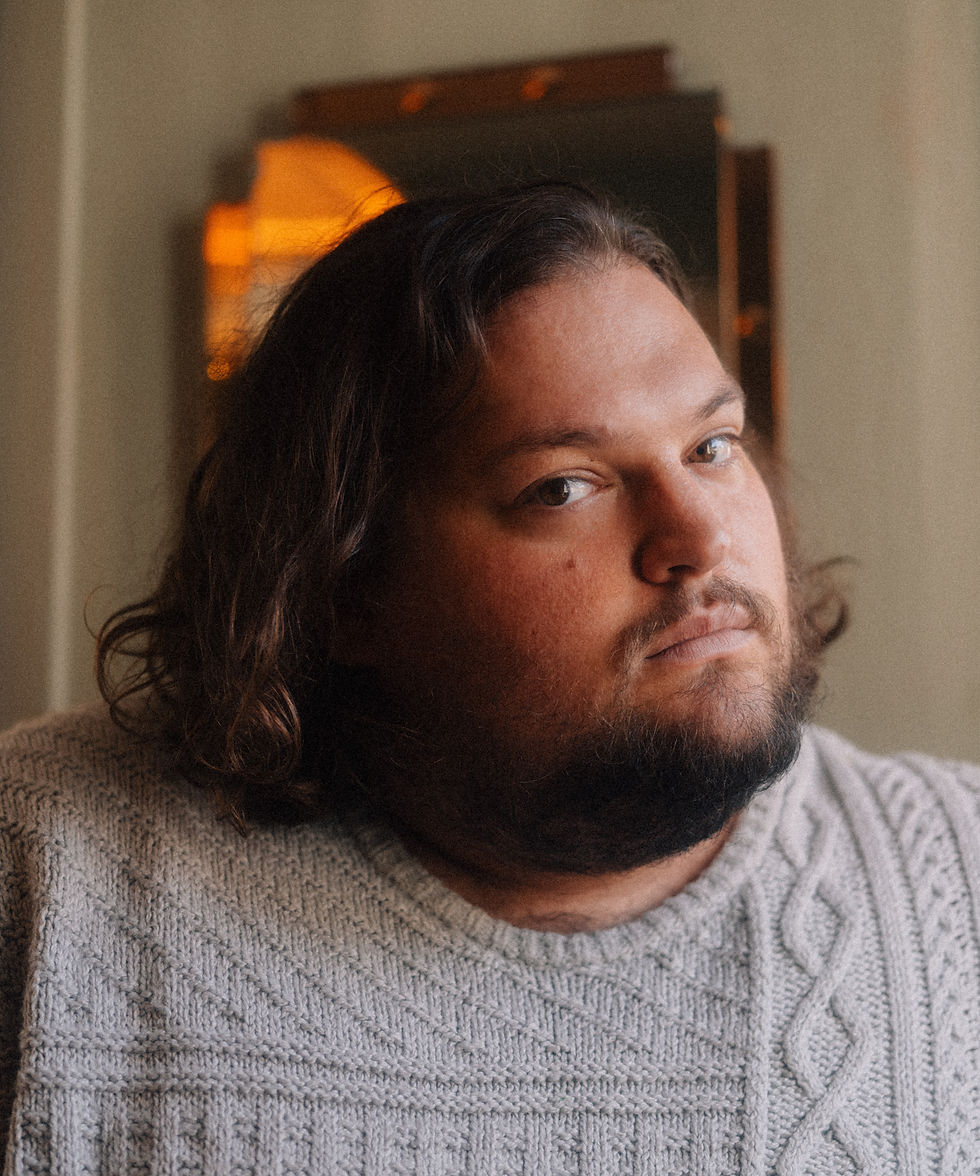
“I love you, I love you, I’ve known you forever / Your fire was and always will be / I learned your name but missed its meaning / When I didn’t know how to feel / Can’t wait to meet you for the first time again,” Rhode Island–born singer-songwriter Tyler Ballgame croons on the title track that opens his debut album of the same name, For the First Time, Again. It’s a tender ballad that gives the listener the first taste of Ballgame’s most impressive instrument: his wide-ranging voice, which he can control down to a tender whisper or expand into an operatic earthquake of a howl—at times reminiscent of Jeff Buckley’s mezzo-soprano impressions or a Leonard Cohen–like whisper, all thrown into an alchemic fusion that comes out entirely Tyler Ballgame’s own. The track serves as Ballgame’s opening salvo on an album where he seeks to impress upon you that true art comes from the love and passion found in the communion of live music and art.

The album's opener is a clever magic trick, preparing you for a gentle listening experience, only to be shaken by the second-track single “I Believe in Love,” where Ballgame truly puts on his performing mask—hinted at in that second “first time” meeting he sings about in track one—belting out over-the-top lyrics and theatrics reminiscent of Joe Cocker with a sprinkle of Roy Orbison's vibrato.
This juxtaposition is very much how Ballgame presents in my interview with him: quiet, reserved, and intentional in what he says and how he says it. Ballgame reminds me of blues legend Howlin' Wolf in this way. Chester Burnett towered over most people with his impressive 6'3" frame and tree-trunk build, but when he wasn’t performing he was gentle and reserved, saving the Wolf—and his magic trick—for the stage, where the audience could be moved in the most effective way. Ballgame is very aware of this artistic device, and it’s what makes his debut so exciting.
Growing up surrounded by a lot of love and art in Rhode Island, Ballgame—real name Tyler Perry—realized early on he had a gift in his voice. He eventually made his way to Los Angeles, where his demos were discovered by Jonathan Rado, the Foxygen leader and producer extraordinaire who has had a hand in making Weyes Blood, MJ Lenderman, and Father John Misty indie pop breakout stars.
The result on Ballgame’s debut is a tight and exciting record full of throwback flavor on tracks like "Down So Bad," and "Matter of Taste." Themes of familiarity and creativity run throughout this album, but through it all, Ballgame remains humble, soaking it in, excited that this is what he gets to do with his life for “at least a little while.” In our wide-ranging chat, we talked about his upbringing in Rhode Island, the sacred connection between performer and fan, getting deep into Cat Stevens, and how he’s excited to see how the next act unfolds.
You've been getting a lot of attention lately. You just did CBS Saturday Morning. You have all these great pieces singing your praises. With all this attention and positive response to your music — how are you staying humble?
It's kind of an unnatural thing for me. It's kind of funny because it's part of your dream. What you want is to be received and recognized as an artist for your work, and I think hearing from a lot of heroes and idols of mine and contemporaries and people that I respect is really awesome. The rest of it I can kind of do without. I think it comes with the territory of playing the game and getting your art out there. I'm a little bit wary of it , or leery of attention on that scale, because with the good comes the bad. I think it's good to stay humble, and just that anyone would want to hear any of the music at all is incredible. It's been really cool seeing people face to face and meeting people who've heard the music, and you can tell that it's transferred into their lives and it's theirs now, which I think is what it's all about.
Tell me about growing up. Was there a lot of music in the house? Talk to me about your first exposure to music and what life was like.
There was always lots of music and art in the house and movies and just an appreciation for art-making and being creative. Me and my brother and my cousins, we kind of all were raised together in Rhode Island. My aunt would teach us art, and my mom would teach us music. So even during the summer, we would be learning things and experiencing things in a fun way. Both my mom and her sister are teachers, you know, so it was very natural.
I was always encouraged to sing and to make music. And anything I ever wanted in regards to music-making or anything, my mom always sacrificed to make sure that I had it, which, looking back, was huge. And just feeling like nothing was impossible, or that I knew that I had a gift, and I knew that it brought joy to people, especially to my family.
To me, this music is so life-affirming. And to hear you talk about bringing that joy and hearing that it was around growing up, it's hard to imagine this record if you didn't have that
Oh, that's beautiful. I love it because it's not really explicitly communicated either. It's more just intuitive. It's just something that's always been in my life. My earliest memories are music and feeling joy and release and freedom and the divine in music. Just being a little kid and hearing classical music and crying and not knowing why. There's music with no words, but it's moving me on a human level as a little kid. That's just always how I relate to reality and existence. It's being freed by music and relating to other people through music.

I think people are responding to this albuim in a similar way. It's something really positive to latch onto right now.
I think that's how it's played out in my journey as well, just being wrapped up in everything that's going on and then needing a sojourn away from that. And that's music, and that's what that's always going to be there for. It's the universal language of love and goodness and love and kindness. And I think it supersedes any division that might be springing up within our egoic world of identity battles. I think there's something bigger that binds us all together. And music is taking me around the world and putting me in front of those people. And I don't take that lightly.
Which leads me to the live aspect. I know that live music means so much to you, and watching you perform live, you can tell. I think you can tell that you've watched so many incredible performers and kind of taken in what you like and what works. It feels like you're a student of some of those great onstage personalities.
I think it's this archetypal thing that exists within the 20th century, within our cultural ethos, and even further — just being on stage and wearing a mask. And I think wearing that mask, for me, is freedom too. It's a character piece, but it's also… I'm trying to disappear. It's not as contrived maybe as like, oh, here's when I go into the Elvis move or this is a Jim Morrison move. It's kind of more that intuition thing of taking in all these things that I've seen and loved and idolized, and then it's going to get mixed up in the prism of my experience and come out as a new light. And through this mask, I can show more of myself than I would have otherwise if I were just Tyler Perry up on that stage. It's the Ballgame now. Anyone can be Ballgame. Anyone could inherit that space and evoke and invoke those archetypes and parts of the pantheon of the human condition and expression.
You could play this music straight, but I think it would be less — maybe not less interesting — but I think that kind of alchemy wouldn’t be there.
Yeah, that’s kind of been found gold. What’s also exciting for me is that it wasn’t all planned out. It was more just following my gut and then kind of sorting it out after the explosion — what it is and what it means. I think the best songs that I write are like that too. I don’t know what they mean necessarily, and then I find out later what it could mean or what it means to me as I continue to sing them. I think that’s the case with the character too. The character was born out of singing [The 2024 single,] “Help Me Out,” and then also getting into the studio with [Jonathan] Rado and putting on the jean jacket and the sunglasses and hearing myself through that microphone and being like, whoa. I can’t just sing it as myself. It needs to be grander. It needs to match the song, and it needs to match how it’s being packaged.
I always bring up Randy Newman in this. He’s building these worlds. Each song is a world, and it’s not necessarily Randy Newman singing the song — it’s a character. There are no rules in songwriting. I don’t have to listen to anyone telling me, “Oh, it has to be this way or that way.” I’m just going to do what excites me in the moment. It’s for you or it’s not. I need to follow what moves that arrow within my gut.
it’s fun to imagine Tyler Ballgame on album three or four and see where it could go even further. Are you thinking that next part of the journey?
Totally. We’re hard at work on [album] two right now, and it’s been cool to see which bubbles of influence and idolatry that I’m resting on for each song. It’s different from the first album. There's a continuation, but it’s also a divergence. Whatever it is, it’s still a mystery, which is something I just need to keep following. I need to keep following something that feels bigger than me and also uniquely of me — like only I could write this, but also I have no clue what this is or why it makes me feel this way.
when I think about an artist's creative evolution, I think a lot about how a 4th or 5th album couldn't have been made by the same artist who made the 1st or 2nd. It’s in that unknowing that I’m excited to see where your journey goes.
Right? I was talking with a reporter about some of those early influences of mine. It’s interesting being 12 or 13 in the early 2000s and getting obsessed with someone like Pete Townshend and The Who, where their journey now is kind of done almost. You see the whole arc of their career, and it’s waiting to be discovered by you however you find it. I’m not used to following an artist where it’s unknown. I really do love old music. I’m not pretending. All I’m interested in going after is the way they used to make music. So it's interesting to think about my journey and say, oh, it’s still being written. Where could it go? What could it be? They always talk about the sophomore album — the first album is five years of writing from desperation, plucked out of a little community. Then the second album is about being in the tour van and making it in three months. Luckily, we’re not doing that, but it’s something to think about for sure.
Well, I'm looking forward to the Tyler Ballgame gospel era. Do you remember the first song you ever wrote?
Yeah, I think I wrote one about sailing or something when I was very young. I don’t remember that one, but I do remember one called “Nine to Five” that I wrote. It was totally a Pete Townshend song about not wanting to have a job — someone sitting outside their nine-to-five in their car not wanting to go in. It’s kind of a weird thing for a 12-year-old to write about. That’s probably the first one I really remember.
Before the record was out, what were some of the album cuts you were you really excited for people to hear?
I was really excited about “You’re Not My Baby.” I think there’s some type of magic there. That was take one, and everything was live, and we just left it. I thought that was some kind of crazy mystery how we captured that. And then I think “Goodbye My Love” really is also very special and just has that kind of spirit inside of it that you chase. And I love "Sing How I Feel.” That's another one that I think is a really kind of defining song for the character and one of the mission statements or pillars of the record and the themes of the record.
One of the most interesting songs to me is “Ooh." I couldn’t help but think of McCartney first record, and the song — “Oo You” — and I hear some of those silly vocal trills on it too, where it's very organic. I really love how it kind of morphs from this noodly kind of thing to a fun little song.
That one was fun. It was very organic in the studio. I dreamed the drum pattern the night before the session, which was wild. So I came in and sang it to Amy and Wayne, and we fleshed it out and got it. I wrote the lyrics kind of Cobain-style, just on the floor in the vocal booth right before we were about to cut it. In my mind, I was thinking Marty Robbins meets Animal Collective.
You've been on tour supporting St. Paul and The Broken Bones, and you're about to go back out with them again, where you'll be playing here in LA on April 3 at the Belasco. Talk to me about playing with them and these shows.
Opening for St. Paul has been very beautiful. They've been very good to us, and the crowds were very cool. The rooms felt like we were peaking. I felt like three of the shows were maybe top 20 Ballgame shows ever. The band felt really good. Then we did a run of in-store performances with signings and meet-and-greets, and that was really special. For about a year now, we’ve been this opening act trying to convert people and convince people with our song-and-dance show that we’re worthy of their Google search or Instagram follow. And then it shifted— you've already convinced them. They’re there for you.
I’m still kind of wrangling with that energy and what that means and how that affects my performance and the energy transfer. But it was beautiful. It was great to talk to people and meet people. Through this leg, we kind of sold out the next tour, which is very good. It just means we get to continue to do what we do. That’s really a blessing. It’s starting to sink in that this is real and it’s growing, and it’s going to be my life for a little while.
What a renowned artist or album that you’re kind of just getting into yourself finally? One of those greats that it took a long time to get into?

There are a couple Cat Stevens records that are really huge for me right now: Teaser and the Firecat and Tea for the Tillerman. Those are massive ones. What’s really affecting me is the use of the drums. There are almost no cymbals, and it’s almost like timpani. The songwriting is so soulful and spiritual and such a thoughtful seeker, but also very pop. There are five or six singles on both of those records, and there are no skips. It feels like people in a room but also elevated. I think it’s a perfect blend.
I’m also really into John Cale’s Paris 1919 right now. He’s another writer who’s super unique and using words that aren’t usually used in songs. Very sardonic and ironic and has that humor baked into this kind of dry, glum kind of guy. But it’s also achingly beautiful. I’ve been getting into those artists.
I love those Cat Stevens records. “Where Do the Children Play?," “Sad Lisa,” "Into White," - that stuff burrows into my brain.

It’s that baroque thing before the Baroque revival of the 2000s. I love Sufjan Stevens, he has that classical music influence that makes it evergreen. It pulls it out of the sphere of its peers and contemporaries and puts it in this other category where it’s like God music.
Best show you’ve ever seen?
Really cool one was I saw this artist BCUC (Bantu Continua Uhuru Consciousness) at Newport Folk Festival last year. It was like 12 o’clock on a Sunday. I wasn’t expecting anything. I was just in the artist area and walked into one of the tents side stage. They're like an Afrobeat, African rhythm-type group. It floored me. It was five or six drummers and three singers and one fretless bass player. It was such visceral music. The whole tent was in the palm of this guy’s hand. I was instantly converted into learning and soaking it up because it was so special. I was transfixed and energized.
It was incredible folk music and modern music for them. It was their first time in America, and it was a special moment. Then I went and sat backstage, and they saw me from like 200 yards away and waved me over. I’m like, they’re not talking to me. They waved me over. I don’t know if they had seen my set or just seen my energy, but they all thanked me and hugged me and we took a big picture. It was insane. And that was in the midst of seeing Alex G and Geese and all these incredible acts. It was an incredible weekend of music. But that one stuck out. One of the most powerful music experiences I’ve ever seen.


Comments