Kid Sistr's American Teenage Prophecy

By: Josh Kitchen , May 21, 2026

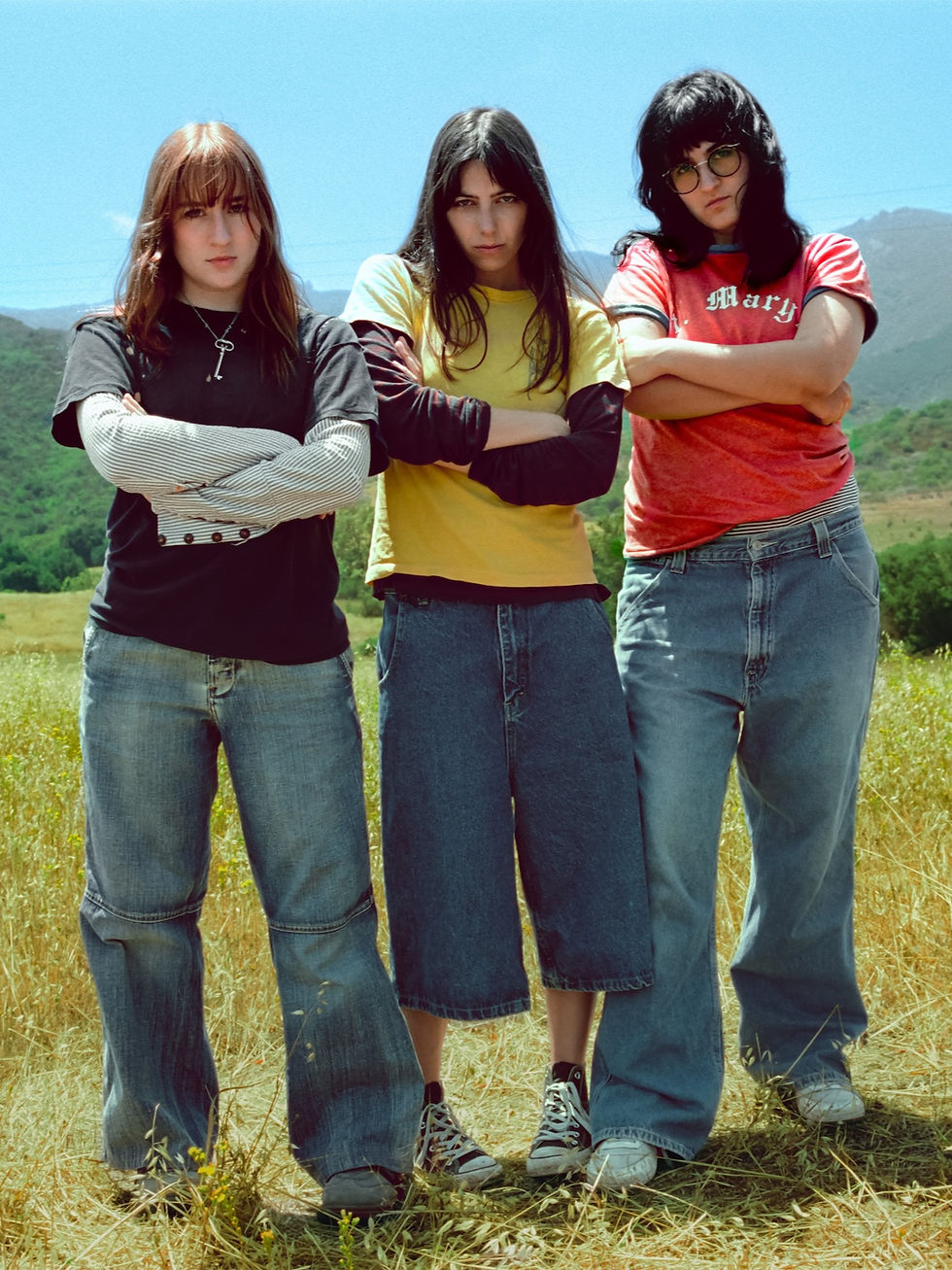
Talking about “American Teenage Prophecy,” off their new EP of the same name, Kid Sistr “imagines a world where queer love is as natural as breathing.” It’s a sentiment that sounds obvious, but still feels quietly radical — a subtle form of protest woven into so many artists’ visions of an equitable society. Comprised of New York natives bassist Sara Keden, guitarist Sabel Englert, and drummer Becca Webster, Kid Sistr find themselves baring their souls across five songs that perfectly encapsulate the exhilarating, confusing, funny, and deeply human experience of trying to understand yourself and the world around you in your twenties. Blending queer yearning in standouts "Boys in Skirts" and the title track, tongue-in-cheek humor on "Shitshow," and sharp indie rock instincts throughout, the trio has crafted an EP that feels both intensely personal and immediately communal.

During our conversation, the band bounced between discussions of Ari Aster's Hereditary and Midsommar, queer history and hip-hop, what they'd tell their younger selves, and the pressure of virality that hung over so many young bands during the pandemic. What emerges from American Teenage Prophecy is a band that has stopped chasing clicks and started trusting their instincts instead. The result is music that feels authentic in the truest sense — messy, emotional, self-aware, hilarious, and completely alive.
Talk to me about what american teenage prophecy means for you as a band.
Sabel:
I think this is kind of like the next step that we’ve been looking forward to for honestly the past three years. We’re really excited about these songs, and we feel like we put together a good group of songs that really represents us now and the messages that we want to put out into the world.
Becca:
A lot of these songs have been a really long time coming. I mean, we started a couple of them literally three years ago. So, you know, it’s been a long road. We’ve taken a lot of time to develop this music, and I think that’s why we feel so confident in it, and we’re so excited to put it out. And a lot of that process was also us establishing our relationship with our lovely Suzy Shinn, our most favorite collaborator and producer, and just finding the sound. But yeah, it’s been a long road, but an awesome one, and we’re excited to finally share the product.
Something I love that you guys said is that you "imagine a world where queer love is as natural as breathing," like we’re all breathing right now. You’re not thinking about it, you know? I think that idea is very exciting and present in your music, especially a song like “American Teenage Prophecy" and its video. Talk to me about that ethos for you guys.
Sara:
First of all, the song was inspired by rewatching The Runaways biopic with Kristen Stewart and Dakota Fanning. That kind of put it in a different time period in our minds, and just kind of having that reference of the ’70s. And then when we were kicking around ideas, we started to think about what it would look like if there were queer girls all across American history, especially in settings that are more conservative, like the nuclear family. We all see those types of art pieces or photos from that time, and it’s like, “Ah, the good old days,” right? We just thought that would be really powerful. And also, there are just so many awesome lesbian period pieces, kind of paying homage to things like Portrait of a Lady on Fire and the other one with Kate Winslet and Saoirse Ronan, where they’re on the beach and they gaze and they yearn and all of that good stuff. So I feel like that’s kind of what we were trying to show — that they’ve always been there.
Sabel:
Always been there. I love that.
queer history is just *history.*
Sabel:
Yeah, I think it’s also that whole insane thing that has completely taken over the minds of homophobic people. It’s like, “Oh, this new agenda is turning people gay.” And I think it’s such an important thing to touch on, because it’s just that it’s a little bit safer now — the tiniest bit — and so people are coming out.
Becca:
I love when there’s this massive historical figure, some pioneer of their field, and then you find out they were just gay. Like, letters get found or something. I feel like that happens all the time.
I'll let my history nerd side come out here - look President James Buchanan. He was right before Lincoln, and he was a famous "bachelor." Lots of historians think he was gay because of close live-in friendships and things like that. He was an awful president, one of the worst until today. He was very much responsible for letting the Civil War kind of just happen and not doing anything intentionally. But he was gay. And in some ways, it’s really important that someone in history, a president, was gay and also a bad guy. It’s okay. You can be gay and terrible, and it’s very much a part of being normalized, you know?
Sabel:
Yeah! And he wasn’t terrible because he was gay.
Exactly. And I think when you approach that idea and write in that way, it’s such a unique part of writing music as queer people and kind of a spot that doesn’t get shown enough.
Sara:
I feel like with art by queer people right now, one of the most exciting things about people being able to be publicly queer is that you get such a massive spectrum of queer art. Whereas in the past, maybe somebody was making art in the hardcore scene. And I do think there are scenes where I would love to see more representation. I think the hardcore scene is one of them where I’m like, “I know some of you guys are taking off your shirts and you’re all ripped. Come on, guys, somebody say it.” But you do get a huge breadth of queer art. I feel like we’re starting to see so much more queerness in hip hop, which is really exciting.
You wouldn’t have had a number one hip hop single if you were gay 20 years ago.
Becca:
And I also think the women are pioneering it. Thinking about Doechii and Megan Thee Stallion — there are just so many incredible female rappers and hip hop artists who have been pretty vocal about their sexualities. I think that’s so incredible, and part of the reason why women are dominating that industry right now.

with Doechii, it was like, “Yeah, I’m gay.” Some people were surprised, but it was literally all in the lyrics.
Sabel:
Yeah. She’s like, “Read the lyrics sometimes.”
Becca:
And she was also an OG Paramore fan. Like, what do you think?
what I also love about your lyrics is that some of them are very tongue-in-cheek and very referential to so much culture that we all consume — talking about Ari Aster on "X-Show." It’s so relatable because movies and cinema and TV shows are the things we all talk about and commune over with our friends and communities. It’s fun to hear that reflected back in that way. Artists are like us — they consume things the same way, and it influences their writing and art from that point of view too.
Sabel:
Yeah, those lyrics were pure, straight from a doobie on Rebecca’s porch. Sometimes that’s when you get…
Becca:
Oh my God, yeah. I do think there’s something to be said for almost entering a different state of consciousness and consuming art — putting yourself in a mindset where you can just consume and be inspired without, in the moment, thinking about how you could create with that perspective. I think just absorbing things later informs you. But yeah, sometimes I feel like I need to just blaze and…
Sabel:
I think we need to do another — we haven’t done that in years. I think we need to do a blazed sesh.
Sara:
I’m glad you like the Ari Aster reference. I love Ari Aster. Sabel and I watched Midsommar when we were still living in Nashville and were roommates.

Sabel:
We watched Hereditary in college, right? We watched it together.
Sara:
Yeah, we were just like, “Oh…”
One of the best horror movies ever, but one and done with that one is ok by me.
Sara:
Exactly.
Sabel:
Yeah, I almost vomited the day after that movie.

that’s such a wonderful thing about art — when it can do that to you. It makes it so exciting. I wonder if you’ve ever thought about your music being that way for people. Is that something you’re cognizant of or have contemplated? I mean, you’re not chopping anybody’s head off or pushing anybody off a cliff, but still.
Sabel:
Yeah, I think it’s a good combo. Obviously, we want everyone with every single song to be able to put their own meaning to it and use their brains. And I also think with songs like that — and honestly all the songs on this EP are pretty literal about one specific thing — but with "X Tape" and with the new songs we’re writing too, it’s always kind of fun to write just a fun, crazy song that everyone can put their own meaning to.
Becca:
It’s like you’re curating the vibe.
And it’s nice to have music that does that, because I feel like everybody is searching for something really authentic. When I hear Kid Sistr songs, you’re putting it all out there, but at the same time there’s enough there that you can really read into. I think people hear your music and relate to it, which is really special.
Becca:
Oh, thank you so much.
You’re welcome. And I’m a 36-year-old cis straight white guy, and if I feel like that, imagine what’s really going on in the streets.
Becca:
Yeah, that’s definitely the goal.
What would you guys tell your 2020 selves when you were just starting?
Sara:
Oh my God. Jesus. Go to therapy. Just get it done.
Becca:
Probably, yeah. Oh my gosh. I would say maybe don’t do your makeup like that. Or you tried, and you did your best.
Sara:
Take that outfit off.
Sabel:
I think also relaxing with social media a bit. I think the second we started to enjoy social media was when we were like, “Fuck it.” We’re gonna talk about whatever we want. During COVID there was literally nothing to do, and there was no way to get anyone to listen to your music except the potential of going viral. A ton of songs were going super viral — not ours, but others. I think we put a lot of work into using social media because there was nothing else to do, but I think we made ourselves suffer from it a little bit. The second we realized we could make what we wanted without thinking, “Will this go viral?” was when it started feeling authentic and fun. So I’d tell myself to have more fun with social media back then.

Some people never have that kind of realization. But if you can use social media in a way that brings you joy instead of horror and brain-numbingness, then it can work. Especially for a band like you guys, using it in a way that gets people interested without sacrificing your ethos and morals.
Becca:
And I think what helped us crack the code with that was leaning into comedy and our ridiculousness. Some of the most successful social media content we’ve put out has just been us on a couch improvising. If you had asked me in 2020 if I’d ever say some of those things on the internet, I would have said you were insane. But giving ourselves the freedom to really go balls to the wall and put out things that we genuinely think are funny and that we would want to watch was really helpful.
Sabel:
And also the pressure of virality. I think since then, both us and the general public have kind of realized that having one song go super viral isn’t always the way to go. Sometimes it’s amazing and sometimes it completely breaks a career. Sometimes it happens at the wrong time or before you’re ready for it. You don’t have to have a song go viral. You can be in it for the long haul and slowly build your audience. There was so much pressure back then — “Tag Harry Styles,” “Look at us singing your song.” And you don’t have to do that.
You don’t have to die being cringe anymore.
Sabel:
And we can be cringe in other ways.
Comedy disarms people, and you get them on your side quickly when you can make them laugh. Obviously you’re not a comedy act, but it’s an interesting way to get people on board.
Sabel:
It is trying to find the balance of that, because no, we are not a comedy act.
And you’re a band that kind of started cooking during the pandemic, when everybody’s life was on the back burner and nobody knew what was going to happen. Obviously COVID is still around, but the world is different now. I was going to ask what lessons you learned, but I think that’s pretty much it — you don’t have to seek virality and social media acceptance the way you thought you did anymore.
Sabel:
Yeah, I think that is a good lesson.
Becca:
One other thing I feel like I’ve learned over the last five or six years is how fruitful it can be to invest time into development. Even with specific songs. I used to think if we couldn’t get it right in one session or a couple sessions, then it just wasn’t worth pursuing. But now I really see the value in dissecting things, getting opinions from people we trust and admire musically, and really piecing it together. Obviously every song is different — some come together quickly and naturally — but there’s nothing wrong with grinding it out.
Catch Kid Sistr at New York Zone One on May 30 and listen to American Teenage Prophecy below:


Comments