May God Bless You, and May Your Bones Bleach in The Sand: Searows On Their Epic New Album, Death in The Business of Whaling

By: Josh Kitchen / February 2, 2026

On Death in the Business of Whaling, the sophomore album from Searows’ Alec Duckart, the insular, muted bedroom-pop intimacy that defined his excellent debut Guard Dog is cast far deeper—dragged into the darkest depths of the sea and sealed away in Davy Jones’ locker.
In those reaches, Duckart has created a record that feels simultaneously grand and intimate, epic and poetic, drenched in gothic nautical imagery. Across nine songs and 42 minutes, Duckart finds solace in the biblical vastness of the ocean, drawing from the imagery of Moby-Dick, Old Testament visions of Jonah in the belly of the whale, and the leviathans lurking in the deepest corners of the human mind.

Duckart hails from Pacific North West and recorded the album in Washington, pulling inspiration from the surrounding natural world and from the skeletal remains of the Peter Iredale shipwreck—a vessel that ran aground more than a century ago and still rests on the beach (that finds itself on the cover of the album itself), endlessly fueling the imaginations of those who encounter it. The album’s title, Death in the Business of Whaling, is lifted directly from Moby-Dick, and Duckart has said, “I started letting myself write about whatever I was interested in without worrying about whether it conveyed something personal in an obvious way.” On Whaling, that approach pays off in full.
“I am not invincible / I am measuring things / I am watching the walls again / Collapse everything,” Duckart sings on the droning, banjo-laden dirge “Belly of the Whale,” a song that sinks slowly, deliberately, into darkness—both oceanic and internal.
Lyrics like this abound on this superb record, with Searows revealing themselves as an essential new addition to the indie-rock canon. I caught up with Duckart to talk about these inspirations in depth—the pull of nature and the sea, the way vast landscapes shape our inner worlds, and how beauty, even in something immense and unknowable, can offer a strange and steady solace.
Alec, your new record, Death in the Business of Whaling just dropped last week. It's such a visual album. And for anybody who loves gothic, nautical imagery — I mean, you're going to be in heaven with this record. Can you talk to me a little bit about the inspiration behind those visually rich, unique ideas and feelings for this album?
Growing up in the Pacific Northwest, with the dreariness of the beaches there and the coastal towns, has always just been so fascinating and beautiful. And I feel like the Pacific Northwest in general has been such an influence on what I write about - all of the nature and water and animal imagery. I also just love movies and books and dramatic visual storytelling so much that I always end up writing stuff that I can picture something to. I love soundtracks and scores, and I feel like I always end up writing stuff that I can visualize.

The cover of the album really does that well - it's you standing on the shipwrecked Peter Iredale - which sank off the coast of Washington over 100 years ago now. The image of the ship's bones on the beach is so evocative, I can imagine that being really inspiring like a haunted house in your neighborhood when you grew up.
Yeah. I feel like seeing a piece of actual history like that — it’s just crazy that was an actual boat once. That and growing up watching The Goonies, and being in the same town where they filmed it — I feel like it was just very formative.
Death In The Business of Whaling is a very epic album title I know you and your partner found it flipping through Moby Dick. I was doing some research about the Wreck of the Peter Iredale. The ship's captain's final toast to the ship as it went down was, “May God bless you, and may your bones bleach in the sand.” Isn’t that epic? The romantic way that Melville in Moby Dick and people of that time talked about their relationship with the natural world is really inspiring. I hear that in this record. It almost feels like, thematically, you’re placing yourself in another time. The language you’re speaking feels like it’s from another era, filtered through how you see the world and your place in it.

That makes sense and really resonates. I feel like it was my own thoughts and experiences in modern times, in my mundane life, but filtered through the drama. Yeah — drama.
What’s a song you’re excited for people to hear that they haven’t yet?
Definitely the first song on the album, “Belly of the Whale.” I’m just very excited for that one. It was a very different process than I’ve ever done before. I made a demo that was pretty much similar to the end product, just recorded much worse — no drums or anything. But I composed most of the elements in the demo and had all of the instruments laid out, and then afterward wrote the lyrics and melody and vocal part. I don’t think I’ve ever written a song like that before, or at least not one I’ve ever put out.
I read that something else new for you on this record was realizing you could write about things that weren’t necessarily true or things that didn’t happen to you — which must have opened up so many creative pathways.

Yeah. Once I realized that truthful songwriting doesn’t have to be literal to be truthful, it was really freeing — and more fun.
I’m wondering what it was like recording this up in Washington — overlooking the Sammamish River. Seeing pictures of that landscape, I can’t help but imagine how inspiring it must have been, especially at night with the fog rolling in. Talk to me about that.
That was such a special experience. The place I stayed was literally a cabin right next to the river. I’d drive this beautiful road with trees on one side and farmland on the other up to the studio barn. Everything had mostly already been written, but figuring out the sounds there was really inspiring. It was also validating — like, this is the right place and the right feeling to be having while making this record.

How does it feel to finally have this record out?
I’ve been imagining it for so long. There were so many stages where I had to be really patient. I was even writing for this album while working on my last EP, Flush. I bought a notebook to write all the lyrics consecutively and scrapbook images from National Geographic that fit the vibe. I initially thought about making it a concept album, but it felt daunting. And now it’s just been sitting on my computer for months. So yeah — it’s satisfying and a relief to finally have it in the world.
And you’re going to be taking it on tour very soon — including the West Coast and LA in June. How are you thinking about playing these songs live?
It’s going to be bigger. It’s a four-person band this time, which adds so much. I’m thinking more intentionally about the structure of the show and the whole picture: the order of songs, the transitions, visuals, lighting, even what I’m wearing — things I didn’t really think about or have the means to think about before.
What’s the last song you listened to that stopped you in your tracks — new or old?
Okay — it was a song by bassvictim called “Grass Is Greener.” It reminds me of music from around 2008 — this kind of millennial hopefulness around when Obama won. I was too young to fully experience that era, but it gives me the same feeling as MGMT. It’s nostalgic, but it’s a new song. I’m really enjoying that, especially being in New York.
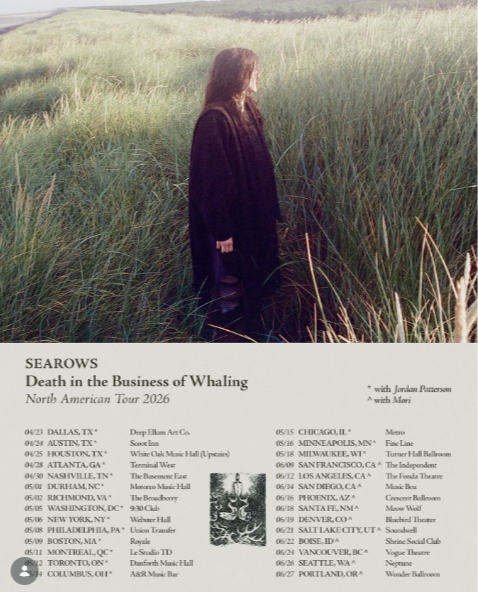
Listen to Death in the Business of Whaling Below, and catch Searows on tour this summer.


Comments